

Diaphragmatic Breathing for Acid Reflux
How You Breathe After Dinner May Change How Much Reflux You Get
A muscle that wraps around the valve at the top of your stomach can be trained, and small clinical trials suggest it may help. Here's how it works, and a simple way to try it.

A few slow breaths, one hand on the belly.
The Valve Has a Backup Muscle
Most people have heard of the lower esophageal sphincter (LES), the ring of muscle that closes the opening between the esophagus and the stomach. Fewer people know it has a partner. Right where the esophagus passes through the diaphragm, a band of the diaphragm itself wraps around it and acts as a second barrier against reflux.
Researchers who model the reflux barrier estimate that this crural diaphragm and the LES each contribute roughly half of it. And the diaphragm is the one part of the barrier you can actually control, because it's the muscle you use to breathe. That raises an obvious question: can you train it?
You can't train the LES directly. You can train the muscle that wraps it.

Two muscles, one valve.
What the Research Shows (and What It Doesn't)
A handful of small trials have tested breathing exercises for reflux. Three findings stand out:
- The immediate effect. In a 2021 randomized trial of 23 people with reflux and 10 without, pressure at the LES was higher during inhalation (42 vs. 23 mmHg). After a standardized meal, breathing exercises brought the average number of reflux events down to 0.36, compared with 2.60 when the same patients were simply observed.
- The effect over weeks. In a 2012 randomized trial of 19 patients, four weeks of abdominal breathing training cut the time the esophagus spent below pH 4 from 9.1% to 4.7%. Nine months later, the 11 of 19 who chose to keep practicing were using far less on-demand PPI (98 vs. 25 mg per week). Those who stopped saw no lasting benefit.
- The big picture. A 2026 meta-analysis of 10 randomized trials and 476 patients found that symptom scores improved with diaphragmatic breathing, but results varied widely from study to study, and quality-of-life scores did not improve significantly.
Promising, but early. The 2026 meta-analysis authors concluded the evidence isn't yet strong enough for definitive clinical recommendations. In the 2021 trial, on the second day of monitoring, total acid exposure was not different from sham breathing. Breathing looks like a low-risk add-on, not a replacement for medical care.
How to Do It: Four Steps
Most people breathe with the upper chest, especially when stressed. The goal here is to breathe lower, into the belly and the sides of the lower ribs.

The four-step practice.
- Sit tall. Feet flat, shoulders relaxed. Rest one hand on your chest and one on your belly. Take a normal breath and notice which hand moves more.
- Breathe in slowly through your nose. Let your belly rise and your lower ribs widen to the sides. The hand on your chest should stay quiet.
- Breathe out slowly through pursed lips, as if blowing through a straw, a little longer than the inhale. Let your belly soften. Don't pull it in hard or brace it.
- Repeat for three to five minutes. If you feel dizzy or start yawning, you're trying too hard. Stop, relax, and start over.
UCLA Health nurse practitioner Suzanne Smith walks through the technique in under eight minutes: Diaphragmatic Breathing | UCLA Integrative Digestive Health and Wellness Program (YouTube).
When to Do It
Timing matters as much as technique. UCLA's guidance is a few slow breaths before and after meals, and the 2021 trial tested breathing after a meal, when the stomach is full and gastric pressure is higher.

A simple routine.
Start small. The trials used longer sessions, averaging about 20 minutes each over roughly five weeks, so it makes sense to build up gradually. And consistency counts: in the 2012 trial, the benefit held at nine months only for the people who kept practicing.
Stop if you feel lightheaded. If you have COPD, asthma or another lung condition, panic attacks, a large hiatal hernia, or have had recent chest or abdominal surgery, ask your doctor first. (The 2012 trial excluded people with large hernias or previous surgery.) And never change or stop a prescribed medication without your doctor.
The One Job Breathing Can't Do
Breathing works on pressure. During the inhale, it may make the valve harder to push open. It does nothing for the tissue on the other side of that valve.
When reflux does get through, the esophageal lining takes the hit. Irritated tissue is more sensitive, which may be part of why the same amount of acid can hurt more over time. That's why a multi-pronged approach makes more sense than any single fix: change the mechanics (how you breathe, how fast you eat, how big your meals are), and support the tissue that takes the exposure.
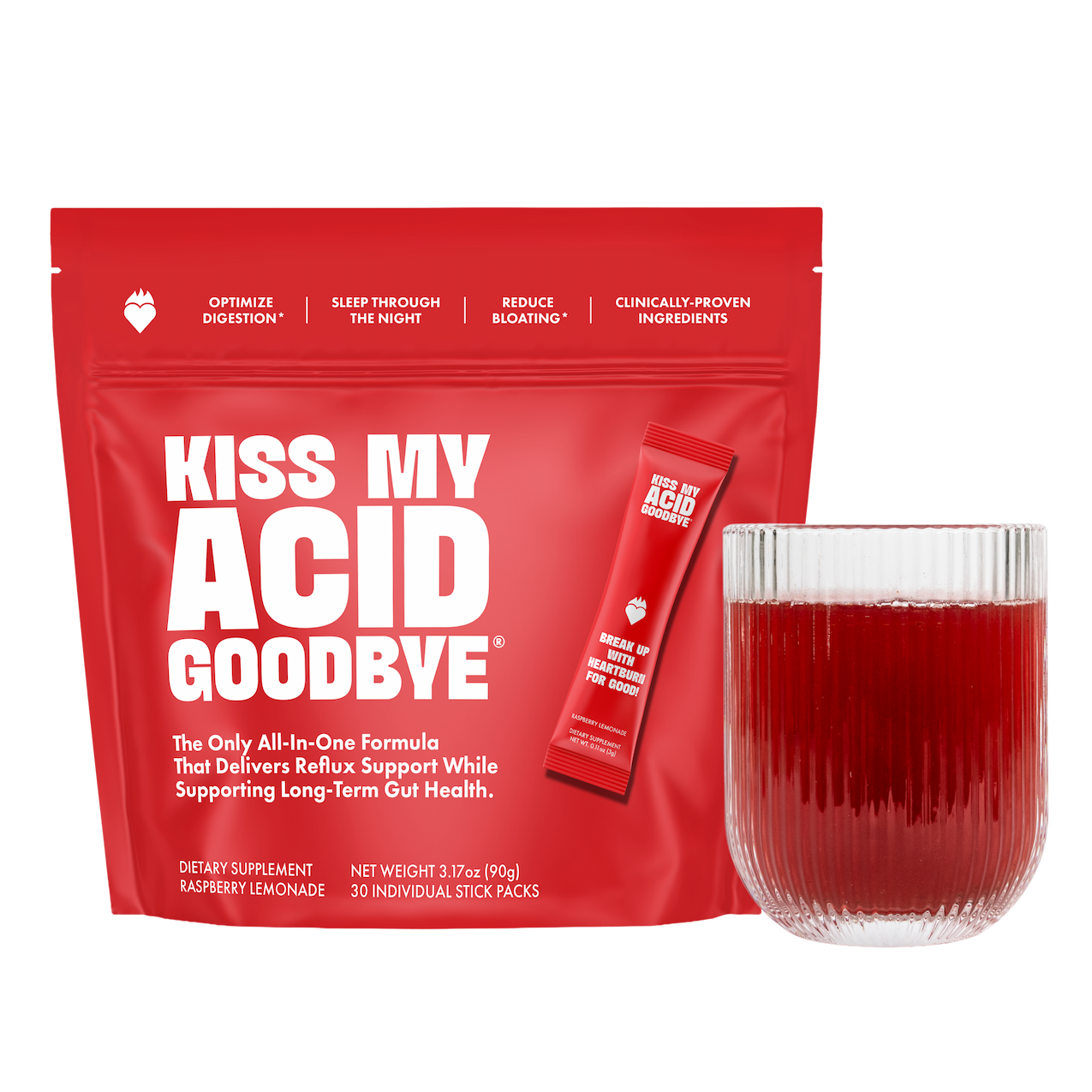
If reflux keeps showing up after meals even when you're doing everything right, KMAG may be worth a closer look.
When you try KMAG today, you get:
- ✓ 100-Day Satisfaction Guarantee*
- ✓ Lifetime access to the KMAG Symptom Tracker and Recipe Converter App
- ✓ Our 7-Day Reflux Reset Program
- ✓ Priority Support from our Human Support Team
*Valid on 90-day protocol bundle
Always consult your doctor or pharmacist before adding any supplement to your routine.
Where KMAG Fits: The Tissue Side
Kiss My Acid Goodbye (KMAG) combines four clinically studied ingredients built around supporting the tissue and the system doing the work, rather than just quieting a symptom after it starts.
- MUCOSAVE (400mg): barrier support. May help form a protective gel coating that bonds to the digestive lining. In a 2-month, double-blind, placebo-controlled trial of 118 adults, a formulation containing MUCOSAVE reduced reflux symptom scores by 59.1% compared with placebo.
- ACTIValoe (150mg): esophageal barrier support. A purified aloe vera extract that may help form a soothing barrier along the esophageal lining.
- GUTGARD (150mg): digestive comfort and tissue support. Our blood-pressure-friendly form of DGL. In a 30-day double-blind study on adults with functional dyspepsia symptoms, 56% of the GUTGARD group showed marked improvement vs. 0% on placebo.
- German Chamomile Extract 10:1 (200mg): anti-inflammatory support for the low-grade irritation that makes a sensitive gut more reactive.
By The Numbers
- MUCOSAVE (400mg), in a formulation: 59.1% reduction in reflux symptom scores vs. placebo. 118 adults, 2-month double-blind RCT (Evidence-Based CAM, 2016). Trial formulation dosed at 6 g/day; not the same product or dose as KMAG.
- GUTGARD (150mg): 56% marked improvement vs. 0% placebo. 50 adults, 30-day double-blind RCT (Evidence-Based CAM, 2012)
Studies referenced apply to individual ingredients in Kiss My Acid Goodbye. Individual results may vary.
What to Actually Expect
You might notice:
- Less bloating
- Better sleep
- Fewer "emergency" antacids
Why it's happening:
- MUCOSAVE and ACTIValoe start supporting your mucosal lining
- Chamomile begins to ease irritation
You might notice:
- Less burning after meals
- More confidence around food
- Fewer middle-of-the-night flare-ups
Why it's happening:
- GUTGARD and ACTIValoe continue supporting tissue repair
- Bacterial balance support ramps up, and motility support may begin to help too
You might notice:
- Testing foods you used to avoid
- Feeling less scared of food and bedtime
- Talking to your doctor about slowly reducing meds
Why it's happening:
- KMAG's ingredients have been supporting your gut barriers and helping calm inflammation
- Your gut is better maintained for long-term comfort and relief
If you have LPR or have been on PPIs for 1+ years, 4 to 6 months is a very normal timeline. Always work with your doctor before changing medications.
What People Are Saying
"I've had lots of digestive issues which kept me feeling uncomfortable throughout the day & affected my mood. Now, 3 weeks in using KMAG and I've been able to forget about my stomach issues and the constant burn of acid reflux. And I didn't have to quit coffee which is such a pleasant surprise! I've had many happy days so it is working for me!"Laura D., Verified Customer
"I have had GERD with a hiatal hernia for years. No matter what I did (taking PPIs, even watching what I eat and drink, stop eating by 4pm, etc.) around 2:30am I would wake up with horrible reflux (even with the head of the bed raised). I have only been using KMAG three weeks and it is miraculous! I can sleep through the night with no reflux! I also don't have any reflux during the day and pain from acid sitting where my hernia is is gone. I am starting to feel like my old self again!"Deborah L., Verified Customer
"I've been able to forget about my stomach issues and the constant burn of acid reflux."Laura D., Verified Customer
The Question Worth Asking
Not just "what should I eat," but "what is my body doing in the hour after I eat?" If reflux reliably shows up after meals, how you breathe, how fast you eat, and how well your lining is supported are all part of the answer. And if reflux persists, or you have trouble swallowing or unintended weight loss, see your doctor.
Try KMAG Risk-Free
Every order includes:
- ✓ 100-Day Satisfaction Guarantee*
- ✓ Lifetime access to the KMAG Symptom Tracker and Recipe Converter App
- ✓ Our 7-Day Reflux Reset Program
- ✓ Priority Support from our Human Support Team
* Valid on 90-day protocol bundle. Commit to AT LEAST 90 days of daily use for best results.
Frequently Asked Questions
Can breathing exercises really help acid reflux?
Small clinical trials suggest they may help some people, especially as an add-on to other measures, but the evidence is early and results vary from study to study. They are not a substitute for medical care.
How long until I notice a difference from diaphragmatic breathing?
In a 2012 trial, changes showed up after four weeks of regular training, and the benefit held at nine months only in people who kept practicing. Start with a few minutes a day and build up gradually.
Can I take KMAG while still on my PPI?
Yes. Many customers start KMAG while continuing their current PPI and work with their doctor over time on whether and how to adjust their prescription. Never stop a prescribed medication abruptly.
How do I take it?
Mix one stick pack in about 8oz of water, 30 minutes before or after a meal (or when reflux is worst).
This is not medical advice. Always consult with your physician before adding new supplements to your routine, especially if you have any diagnosed medical conditions or are currently taking prescription medications. These statements have not been evaluated by the Food and Drug Administration. This product is not intended to diagnose, treat, cure, or prevent any disease. Clinical study data referenced applies to individual ingredients in Kiss My Acid Goodbye and not to the formula as a whole. Individual results may vary.

