

Medications That Worsen Acid Reflux
Five Common Prescriptions Are Quietly Working Against Your Reflux. Almost Nobody Connects the Dots.
Blood pressure medication, antidepressants, NSAIDs, and a handful of others can trigger or worsen reflux through two completely different mechanisms. Most patients are never told which one applies to them.

The medicine cabinet rarely gets blamed for reflux. For several common prescriptions, it should be one of the first places people look.
You Did Everything Right. It Still Got Worse.
Cut the trigger foods. Stopped eating late. Lost a little weight. Did the things every reflux article tells you to do. And somehow, the burning kept happening, or started happening for the first time, in your late 40s or 50s, with no clear cause.
Here is a question almost nobody asks at a 10-minute primary care visit: what else are you taking?
Not as an accusation. As a genuine blind spot in how reflux gets diagnosed. A doctor managing your blood pressure is focused on your blood pressure. A psychiatrist managing your depression is focused on your depression. Neither one is necessarily thinking about your esophagus, because that is not the system they are treating. The connection between a medication prescribed for an unrelated condition and a flare in reflux symptoms often goes unmade for months or years.
Two Completely Different Ways a Medication Can Cause This
Reflux medications get discussed constantly. The other medications that can cause or worsen reflux barely get mentioned, and they work through two separate, well-documented mechanisms.
Mechanism one: drugs that relax the valve. The lower esophageal sphincter (LES) is a ring of smooth muscle that is supposed to stay closed except when food passes through. Several drug classes relax smooth muscle as part of how they work, and the LES is smooth muscle too. When it relaxes more than it should, stomach contents move upward.
Mechanism two: drugs that injure the tissue directly. A separate group of medications does not touch the valve at all. They sit against the esophageal lining, or irritate the stomach's protective mucus layer, and cause direct chemical damage. The result feels identical to acid reflux, but the cause has nothing to do with sphincter pressure.
Same symptom. Two unrelated causes. And most people taking one of these medications have no idea which category, if either, applies to them.
Tricyclic antidepressants, SSRIs, and SNRIs are associated with an increased risk of developing GERD, erosive esophagitis, and esophageal stricture, an association that grows stronger with more than 10 years of continuous use.
Why This Turns Into a Cycle
Here is the part that makes this worse than a simple side effect. A patient develops reflux from a medication prescribed for something else. The reflux gets treated, often with a PPI or antacid, as its own separate problem. Nobody revisits the original prescription, because the reflux now appears managed. The patient is on two medications instead of one, the underlying mechanism causing the reflux was never addressed, and if the PPI gets reduced or stopped, the reflux returns immediately, because the actual cause never left.
This is not a hypothetical. It is one of the most common patterns described in the gastroenterology literature on drug-induced reflux: the trigger gets missed, the symptom gets suppressed, and the medication list keeps growing.
"Two completely different classes of medication can produce the exact same burning sensation, through two completely different mechanisms. Most people taking one have never been told."

Two unrelated mechanisms, the same burning sensation. Knowing which one applies changes the conversation worth having with your doctor.
The Two Lists Worth Knowing
Drugs associated with LES relaxation (mechanism one):
- Calcium channel blockers, commonly prescribed for high blood pressure (nifedipine, amlodipine, and related medications)
- Nitrates, used for chest pain and some heart conditions
- Tricyclic antidepressants, SSRIs, and SNRIs
- Anticholinergic medications, used for overactive bladder, certain Parkinson's treatments, and some allergy medications
- Benzodiazepines, including diazepam and related anti-anxiety medications
- Beta-agonist inhalers used for asthma and COPD
- Progesterone-containing hormone therapies
Drugs associated with direct tissue irritation (mechanism two):
- NSAIDs, including ibuprofen, naproxen, and aspirin
- Bisphosphonates, common osteoporosis medications
- Oral iron supplements
- Potassium supplements
- Certain antibiotics, including doxycycline
This is not a reason to stop any of these medications on your own. Many of them are treating conditions far more dangerous than reflux. This is a reason to have a specific conversation with your doctor or pharmacist: is the timing of your reflux connected to when you started this prescription, and is there an alternative or an adjustment worth discussing.
What Real Relief Actually Requires
If a medication is part of the picture, three things matter, regardless of which mechanism applies:
1. Identify it, with your doctor or pharmacist, not on your own. Never stop a prescribed medication abruptly based on an article. Bring the timeline to your next appointment: when did the reflux start, relative to when the prescription started or changed.
2. Address what's actually adjustable. Sometimes there's an alternative medication in the same class with a different side effect profile. Sometimes there isn't, and the medication stays, because the condition it treats matters more.
3. Support the tissue itself, independent of the cause. Whether the trigger is a relaxed sphincter or a direct irritant, the esophageal and stomach lining still needs the same things: a protective barrier, reduced inflammation, and support for the body's own repair process. This is true whether or not the medication can be changed.
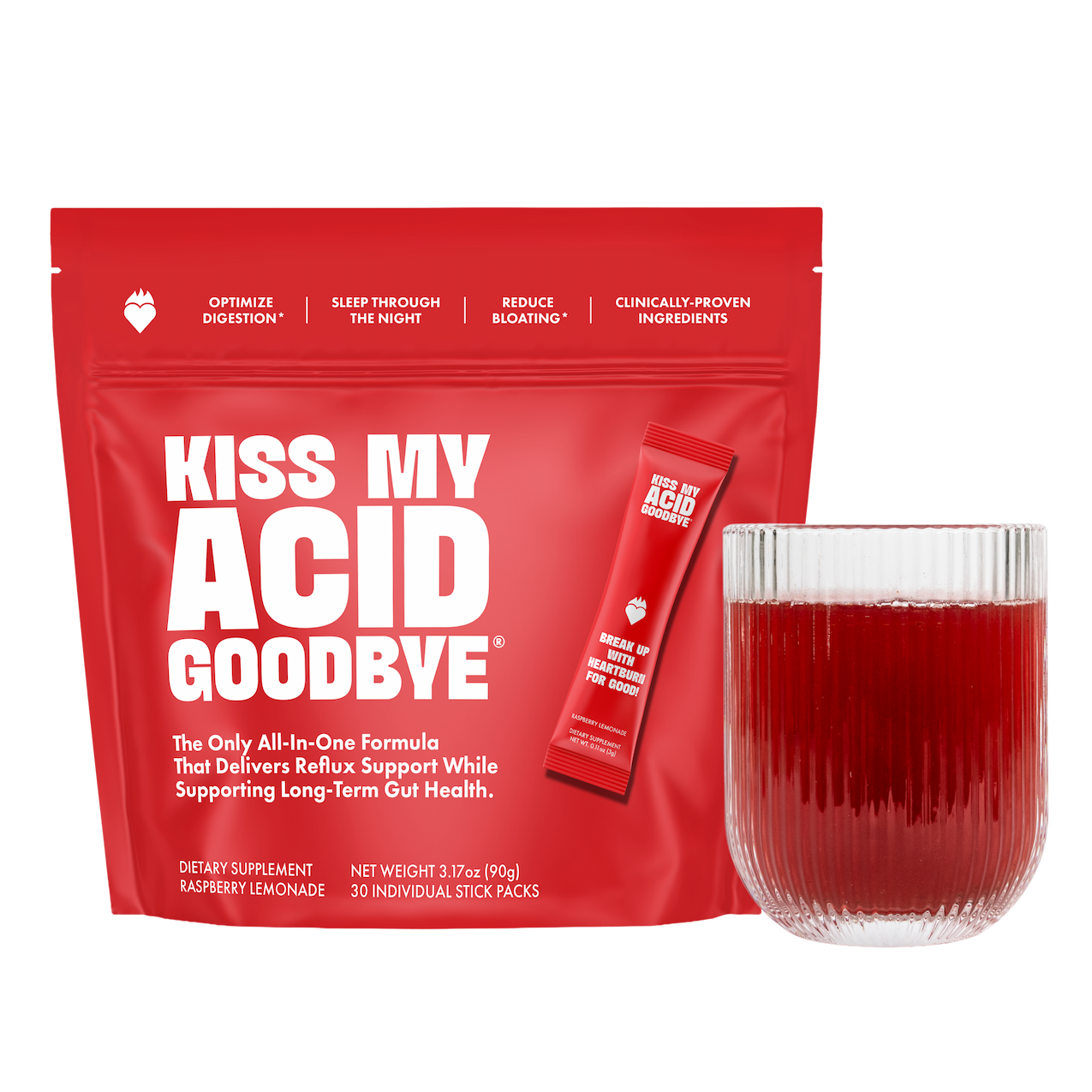
If you're on one of these medications and your reflux has been getting worse without an obvious dietary explanation, Kiss My Acid Goodbye (KMAG) may be worth a closer look. It's built to support the same protective barriers that medication-related irritation wears down, regardless of what's causing the irritation in the first place.
When you try KMAG today, you get:
- ✓ 100-Day Satisfaction Guarantee*
- ✓ Lifetime access to the KMAG Symptom Tracker and Recipe Converter App
- ✓ Our 7-Day Reflux Reset Program
- ✓ Priority Support from our Human Support Team
*Valid on 90-day protocol bundle
Always consult your doctor or pharmacist before adding any supplement to your routine.
The Research Behind Kiss My Acid Goodbye
Kiss My Acid Goodbye (KMAG) is a daily supplement drink mix built around four root causes of reflux that conventional treatment largely ignores, regardless of what originally triggered the irritation: damaged protective barriers, chronic inflammation, bacterial imbalance, and impaired natural healing. That root-cause framework matters most precisely in situations like this one, where the trigger can't always be removed.
MUCOSAVE (400mg): Barrier Support
A patented blend of prickly pear polysaccharides and olive leaf biophenols, sourced from family farms in Sicily, Italy. MUCOSAVE forms a protective gel barrier that may help shield the esophageal and stomach lining from irritation, whatever the source. In a 2-month double-blind, placebo-controlled study of 118 adults published in Evidence-Based Complementary and Alternative Medicine (2016), MUCOSAVE showed a 74.3% total improvement on the GERD-Health Related Quality of Life Assessment.
GUTGARD (150mg): Motility Support
A proprietary, deglycyrrhizinated licorice extract, with the compounds that can raise blood pressure safely removed. GUTGARD stimulates the stomach's natural protective mechanisms and may support gastric motility. In a 30-day double-blind, placebo-controlled trial, 56% of the GUTGARD group showed marked improvement, compared to 0% in the placebo group.
ACTIValoe (150mg): Esophageal Tissue Support
A safety-processed aloe vera extract that may help form a soothing barrier along the esophageal lining, an area with no natural protective lining of its own. ACTIValoe also supports absorption of B12, C, and E, nutrients that matter even more when a medication regimen is already complex.
German Chamomile Extract 10:1 (200mg): Anti-Inflammatory Support
A concentrated extract 10 times more potent than standard chamomile tea, providing anti-inflammatory support throughout the digestive tract and addressing the inflammation that makes already-irritated tissue more sensitive to everything that touches it.
By The Numbers
- MUCOSAVE (400mg): 74.3% total improvement on GERD Quality of Life Assessment. 118 adults, 2-month double-blind RCT (Evidence-Based CAM, 2016)
- GUTGARD (150mg): 56% showed marked improvement vs. 0% in placebo. 50 adults, 30-day double-blind RCT (Evidence-Based CAM, 2012)
Studies referenced apply to individual ingredients in Kiss My Acid Goodbye. Individual results may vary.
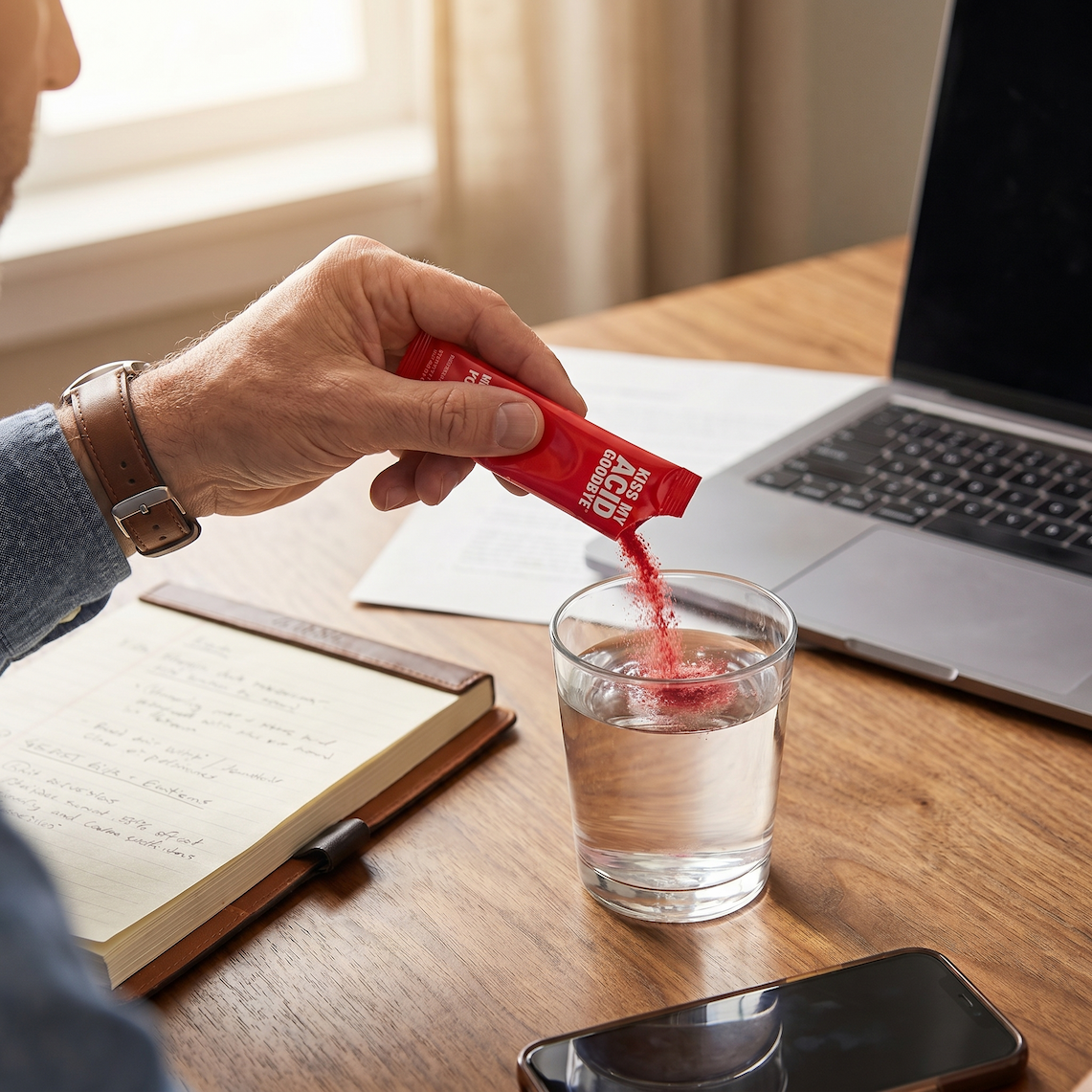
KMAG is taken once daily, mixed into about 8oz of water, ideally close to your largest meal or at the time of day when reflux tends to be worst.
What to Actually Expect
This isn't an overnight fix, and if a medication is part of what's driving your reflux, that's worth being honest about upfront. Real tissue support takes consistent, daily use.
You might notice:
- Less bloating
- Better sleep
- Fewer "emergency" antacids
Why it's happening:
- MUCOSAVE and ACTIValoe start supporting your mucosal lining
- Concentrated Chamomile begins to ease irritation
You might notice:
- Less burning after meals
- More confidence around food
- Fewer middle-of-the-night flare-ups
Why it's happening:
- GUTGARD and ACTIValoe continue supporting tissue repair
- Motility and microbiome support ramp up
You might notice:
- Testing foods you used to avoid
- Feeling less anxious about meals and bedtime
- Talking to your doctor about your full medication list
Why it's happening:
- KMAG's ingredients have supported your gut barriers and reduced inflammation
- Your gut is restored for long-term comfort and relief
If you've been on a medication from either list for years, or you're also managing a PPI or H2 blocker, 4 to 6 months is a completely normal timeline. Always work with your doctor before changing any medication.
What KMAG Customers Are Experiencing
"Because of KMAG, I've been able to reduce my medication from two PPI pills, multiple Rolaids, and an H2 blocker daily to just one H2 blocker at night. I could likely wean off that as well, though a hiatal hernia makes things a bit more complicated. Now, I can eat almost anything that used to be a trigger."Christian G., Verified Customer
"After just 6 weeks of KMAG once daily, my bloating decreased almost immediately and my chronic cough has drastically reduced. I'm now confident enough to discuss weaning off my PPI with my gastroenterologist. KMAG has given me hope for addressing the root cause rather than just suppressing symptoms."Pamela W., Verified Customer
"I started KMAG 3 months ago and now I've been able to work with my doctor to gradually reduce my PPI dose, from 40mg daily down to 20mg every two days with no issues at all. I'm almost completely off PPIs now, which I never thought would be possible."Becky S., Verified Customer
"I've already been able to lower my PPI prescription down from 20mg to 10mg, and with consistency of using KMAG I hope to be off of them completely soon. It's going great so far!"Codi M., Verified Customer
"I've been able to reduce my medication from two PPI pills, multiple Rolaids, and an H2 blocker daily to just one H2 blocker at night."Christian G., Verified Customer
The Question Worth Asking Your Doctor
Not "should I stop my medication," and not "is this medication bad." The more useful question is simpler: could the timing of my reflux be connected to something else I'm taking, and is there anything worth adjusting? That question alone surfaces a connection most ten-minute appointments never get to.
Try KMAG Risk-Free
Every order includes:
- ✓ 100-Day Satisfaction Guarantee*
- ✓ Lifetime access to the KMAG Symptom Tracker and Recipe Converter App
- ✓ Our 7-Day Reflux Reset Program
- ✓ Priority Support from our Human Support Team
* Valid on 90-day protocol bundle. Commit to AT LEAST 90 days of daily use for best results.
Frequently Asked Questions
Could my blood pressure medication or antidepressant really be causing my reflux?
Possibly. Several medication classes, including calcium channel blockers, nitrates, and certain antidepressants, are associated with relaxing the lower esophageal sphincter, which can allow stomach acid to move upward. This doesn't mean you should stop taking it. Talk to your doctor about the timing and whether an alternative exists.
Should I stop taking my medication because of this article?
No. Never stop a prescribed medication without consulting your doctor. Many of these medications treat conditions more serious than reflux. This article is meant to help you have a more informed conversation with your doctor or pharmacist, not to suggest stopping anything on your own.
Can I take KMAG while still on my PPI?
Yes. If you are currently on a PPI, do not stop when you start KMAG. The recommended approach is to take KMAG daily for the first 2 to 3 months while staying on your current medication, then work with your doctor to taper down.
Will KMAG interact with my medications?
KMAG's ingredients are botanically derived and have been studied for safety, but always consult your physician or pharmacist if you are managing serious conditions or taking multiple medications. One practical note: take KMAG at least 2 hours apart from prescription medications, as ACTIValoe may temporarily affect absorption timing.
How do I take it?
Mix one packet in 8 oz of water, ideally before your largest meal or at the time of day when reflux is most frequent. For severe symptoms or long-term PPI users, two servings daily is recommended for the first two months.
How long before KMAG starts working?
Initial improvements typically appear within the first one to two months: less bloating, fewer antacids, better sleep. The most significant improvements come with three to six months of consistent daily use. The 30-day money-back guarantee gives you a risk-free window to get started.
This is not medical advice. Always consult with your physician before adding new supplements to your routine, especially if you have any diagnosed medical conditions or are currently taking prescription medications. Never stop or change a prescribed medication without consulting your doctor. These statements have not been evaluated by the Food and Drug Administration. This product is not intended to diagnose, treat, cure, or prevent any disease. Clinical study data referenced applies to individual ingredients in Kiss My Acid Goodbye and not to the formula as a whole. Individual results may vary.

